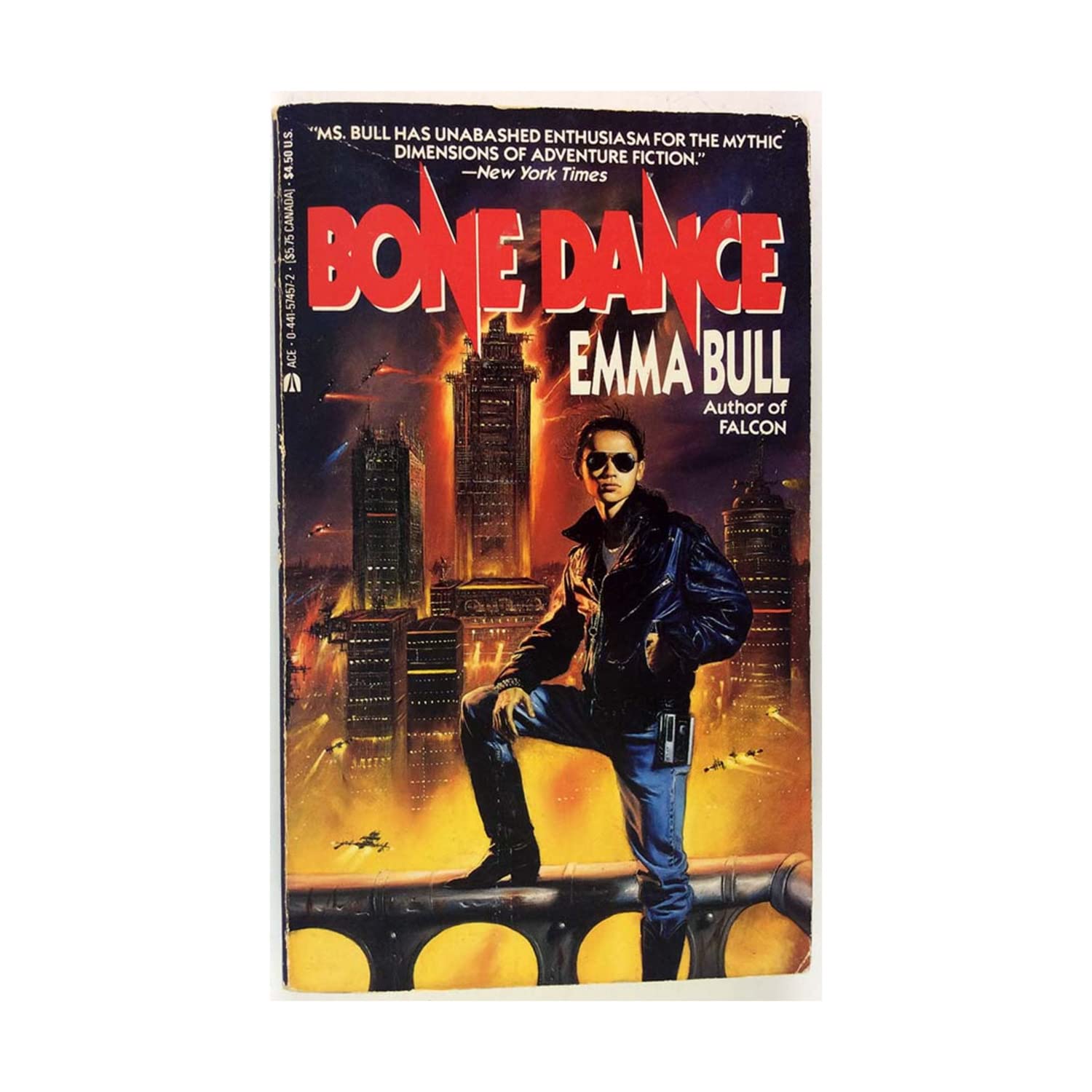
Bone Dance
核戦争後の都市で、映像を売買するスパロウが精神操作兵器「ホースメン」の情報を追うテクノファンタジー。サイバーパンク、タロット、ブードゥーの要素が交錯する。
作品情報
壊れた未来都市で、自分の心さえ信用できない取引が始まる。
エマ・ブルの代表作の一つ。SFとファンタジーの境界を崩し、自己同一性や身体、記憶の不確かさを硬質な語りで描く。
レビュー要約
-
題材の独自性と描写の密度が評価される一方、時代背景や文体の癖に読み手を選ぶ面もある。
書籍情報
- 出版社
- Ace
- 発売日
- 1991-05-01
- ページ数
- 288ページ
- 言語
- 英語
- ISBN-13
- 9780441574575
- ISBN-10
- 0441574572
- 価格
- 1899 JPY
- カテゴリ
- 洋書/Science Fiction & Fantasy/Fantasy
Fifty years after nuclear Armageddon, Sparrow, a trader of pre-war CDs and videotapes, unwittingly possesses the secret to the Earth's destruction, and he is soon drawn into the mystery of the Horsemen, the Pentagon's telepathically trained soldiers
レビュー
-
Fantastic fantasy-sci fi cyberpunk novel
“Death, the Sun, the Lovers. Lots of major arcana. Your future's controlled by others. There's powerful people playing with it. You're gonna have to fight to get it back...this is the country of truth. There the Devil, the Star, the Tower. In this country of truth, where your spirit lives, your life still isn't your own. Other stronger spirits, or maybe gods--they've got the say in what happens to you.” Content warning for talk about sexual and physical abuse and minor spoilers for Bone Dance. In a city gripped by a single man with a monopoly on energy, Sparrow is what I’d call a Nostalgist. They find old curiosities and sell them to people who can afford to collect remnants of the past in a future that only serves the wealthy and privileged. “Happiness, in the land of Deals, is measured on a sliding scale. What makes you happy? A long white silent car with smoked-glass windows, with a chauffeur and a stocked bar and two beautiful objects of desire in the back seat? An apartment in a nice part of town? A kinder lover? A place to stand that's out of the wind? A brief cessation of pain? It depends on what you have at the moment I ask that question, and what you don't have. Wait a little, just a little. The scale will slide again.” After a big deal, Sparrow remembers nothing of the night before, waking up with a killer headache. Turns out it isn't booze. A horseman took her body for their own and now powerful forces are coming for Sparrow. It's harrowing and heavy material and not for the faint of heart. “Suddenly I could imagine all the things my body might do when I wasn't there to stop it and I felt so vile they might as well have happened. Maybe they had; they just hadn't left marks. I thought about a future full of blank spaces, and I knew I couldn't bear it. If that was the future, I had to escape it.” I say “them” because, in this young adult cyberpunk novel, fantasy elements are bolted on; often to great effect. The story goes that years back these horsemen created by the government were made to be perfect weapons. They can infiltrate anyone’s mind, pushing their consciousness down—sometimes long enough to kill them outright. They made political changes and shaped the future, engaged in social engineering, topples empires from the inside. But their lives also cultivated a kind of insanity within them. The Big Bang. A horseman turned a key and detonated a nuclear bomb, ushering in a dystopia. This same government also created androgynous bodies supposedly devoid of thought that were to be used by these horsemen. One of the main points of tension is the origin of Sparrow however, because bodies such as theirs are meant to be empty and waiting. They pass for male or female depending, generally, on the people they’re around at the time. Sparrow leveraged this to fade into the background and make a life in the shadows. They don’t really have close friends and their life, ironically, is in their media collection, which is massive and references pop culture from before the book was made. This past is the only thing they care about. Not their own; the history of others. “Her skin was translucent pale, the complexion of the rich. Money made an excellent sunblock.” But that anonymity is no longer an option as they get embroiled in a plot that puts them at a crossroads with horsemen at the other ends. As the story unfolds, we learn about Sparrow as they learn about themselves. Often painfully. Cyberpunk often puts marginalized on display but this time it’s embodied fully in Sparrow. Performing gender, unfair power dynamics, and forces and powers people really don’t understand but are none-the-less leveraged for their own selfish ends, are placed front and center in the fiction. “The origin of my body and my mind didn't matter. I, the part of me that learned, that called on my memories, that knew I'd pulled a plant like this before, that had moved this hand to do it, was fifteen years old and innocent of evil or good. Neutral. From here forward, I was blank tape; what would be recorded there, and when, and why, was up to me.” A major component to the fantasy elements in Bone Dance is Voodoo. The perception of nature parallels the discovery Sparrow goes through as they have to confront their past and rely on others for help in a way they’ve never allowed themselves to do before. Humanity’s view on supernatural forces, specifically in terms of Tarot and its subjectivity, is similarly paralleled. The major chapters are even introduced with tarot cards. But those answers rely on an interpretation which is flawed for the reader (at least, in my own experience) because of the power dynamics we’ve created with capitalism; so this information often acts as misinformation. “From the lip of the Ravine I could see the Deeps on the other side, hard gray and brown brick on wood on the nearest structures, shading further in to rose, bronze, black pearl, and verdigris in spires of stone, metals, and brilliant glass. The empress of it all, rising from the center, was Ego, the tallest building in the City, whose reflective flanks had no color of their own, but worse the sky instead--relentless, cloudless blue today. The towers of the Deeps, rising in angles or curves, were made more poignant by the occasional shattered forms of their ruined kin.” Bone Dance is also filled with some of the best prose I’ve read. A character that is unique and intersectional. One in which feels like the handling around gender identity is done well, though I can’t speak to that much. I’m not one for fantasy usually, but this, as with other genre mashups I’ve read lately, has some of the very best work in cyberpunk I’ve consumed. Published in 1991, it’s interesting that there is another example of intersectional cyberpunk that is more progressive than most of what was coming out in that space at that time (and discards some of the problems in the first wave) and was released 2 years before it was declared dead with Snow Crash, no less. While Sparrow discovers themself, they also have to confront their place in the world via these themes around nature because their body doesn’t fit the societal norms. This is tethered to the notion around popular spirituality being polluted by the environment we’ve created. How can we really have a grip on a truth that might be held in spirituality and spiritualism when our reality is rooted in capitalistic notions that conflict with and destroy nature. It’s also about trauma and how Sparrow chooses to process theirs. And the marks it leaves under the skin, forever. I don't trust memory, anyway. Why should I? Memories, however undependable, ought to be the stuff on the sand when the tides of experience recedes. As long as they're part of that process, there's something valid about them, something that ties them to real life.
-
A Treasure For The Bookshelf
Wow. What a world. After the Big Bang hit and the bombs came down like rain, the world changed. Humanity has changed, but in some ways we've stayed the same. The ability to record videotape and its cousins is gone. The tech still around is constantly in need of repair. Handymen are in high demand. And people like Sparrow, who collect and trade in old CDs, video tapes, and the technology to parse them? They can demand their pay in gold. Lyrical and flowing, this book is a sensory treat and a powerful work. I love the sense that there's magic to be seen out of the corner of your eye. If you ask the characters straight, they'll talk tech, most of them. But look quick and you'll see the veves and the amulets, the oracle decks and the power they're weaving into the wires. Blending magic and tech is a tricky business. But here it's done to perfection. Everything works itself into a crazy-quilt of whatever survivors can remember: ritual and resistors, solar panels and spells. It all blends in a perfect tossed salad of shook up culture as the City pieces itself back together, piece by piece and year by year. Humanity has returned to their old certainties: trade in kind. Barter. And the deities. In this shook-up world and this knocked-back New York, the religions have mixed and blended. Now the Loa are called on in blessing and curse by all peoples, and the marks of the Santos are painted on the doors of everyday folk. Humanity has been humbled, and in our weakened state, we reach out to our gods again. There's a funny sort of resilience to this story: people got knocked to their knees, but they're slowly standing up. If you've read The Windup Girl, you'll recognize a similar make-it-work tenacity here. Those who have survived are rebuilding the world brick by brick and wire by wire. Being ingenious and good at repair is the work of every person in the community again. People have adapted to a new world with new tricks up their sleeves. It isn't a nice world, but it is a living and breathing one. Above, I mentioned people like Sparrow. But there aren't that many people like Sparrow. They are, in their own words, neuter: what we would call non-binary today. And they are pretty amazing. So is their ability to keep alive the memory of the past. They live for their archive. They think they have no friends. But for someone who thinks they're alone, they have a really solid support crew of waifs, strays, wanderers and gods at their back. Everyone from the body-hopping huntress Frances to the sweet and slightly spooky Sherra, to the absolutely terrifying and powerful China Black, create an amazingly vivid Alphabet City of talented and amazing characters piecing the world together as best they can. Each character is a distinct personality full as a pomegranate with secrets and facets. Sparrow's community feels like some of the bohemian groups I've hung out in, and I love that. This work's a serious head trip and no mistake. Starting innocently enough with Sparrow's odd blackouts, it leads you dark and twisting alleyways of intersecting lives, motivations both human and not, and a hunt that enmeshes the souls of anyone caught in it. A battle of wills between immortals: one craving freedom, one bent on revenging the entire Western Hemisphere. And poor Sparrow is stuck in the middle of it all. Right where they never wanted to be. I won't give away the twists and turns, but I will tell you that every page of it is worthwhile.
-
Bone Dance is great
Emma Bull is a splendid writer, and this is a great book. Set in the (post apocalyse) future, with a great hero, good action, subtle characters, and lots of fine imagination. I loved it.
-
Classic "Fantasy for Technophiles"
Emma Bull handles this 1991 fusion tale of a post-apocalyptic civilisation arising from the dregs of a high tech past with great skill and conviction. I don't know who started this particular ball rolling - Bull or William Gibson - one recognizes common elements. Bull isn't derivative in "Bone Dance"; working with some of the same elements as Gibson but with her own unique take on the material. I enjoyed the mix of science, technology & spirituality, the melange of old & new deities, genetic manipulation, spiritual and mundane motivations and twisting plot elements mixed in with old-movie references, Voudon and gender politics. Good writing, lots of unexpected plot developments - a satisfying story told well.
-
The Friendship of the Soul
Ms. Bull does not have very many titles to her credit, but each one of them is very unique, very different from the average run-of-the-mill fantasies that clutter up the bookstore shelves. Bone Dance starts with a post-nuclear setting, but rather than a world of deserts and a civilization blasted back to stone-age technology, here we still have cities, electricity, even full-flavored showings of old movies and music clips intertwined in the best traditions of artistic DJ's. Of course, the infrastructure that produced the technological goodies needed to do such shows no longer exists, thereby providing employment for Sparrow, our first-person narrator, as he is one of the few that still has the necessary knowledge of electronics to repair this gear when there are the inevitable breakdowns. Sparrow has a problem, however, of having `blank' spots in his memory, times when he can't remember what he did or where he went, only knowing that where he woke up is far from when his last memory says he was. Finding out the answer to these blank spots involves tarot cards, the Horsemen, the dictator of the city, a search for revenge on the person who helped instigate the nuclear war, hoodoo magic, and a cast of very well realized characters. Each of these characters have their own pasts and problems, and they all grow and change considerably during the course of this book's action. Some of the action is very `unpretty', almost gross, but provides a strong line of plot thread that well illuminates one of the main thematic points here, of the importance of friendship and community and that the means to find these things involves baring your soul a bit to others. The odd meld of magic and technology here is refreshing, with some interesting descriptions of the meaning behind the various tarot cards, something I don't normally subscribe to, but Ms. Bull makes them an integral part of the plot, and here it works well. A strong book with a taut plot that is not telegraphed, highlighted by characters that are very different but quite recognizable, a setting and a group of ideas that are not just a rehash of stuff seen hundreds of times elsewhere, all are very good. I had some quibbles with some of the minor characters not being presented with enough force to make them memorable when they reappear after fifty page gaps, and I found some of the descriptive work either over- or under-done, sometimes leaving me floundering about just what the scene was or wishing she would get on with the story. These are definitely minor quibbles, however, as the general prose is quite adequate, the story line engrossing, the main characters real. Recommended for all those readers who are tired of crumbling castles and yet another dragon quest. --- Reviewed by Patrick Shepherd (hyperpat)
関連する文学賞
- フィリップ・K・ディック賞 第10回(1991年) ・特別賞